Quantum foundations
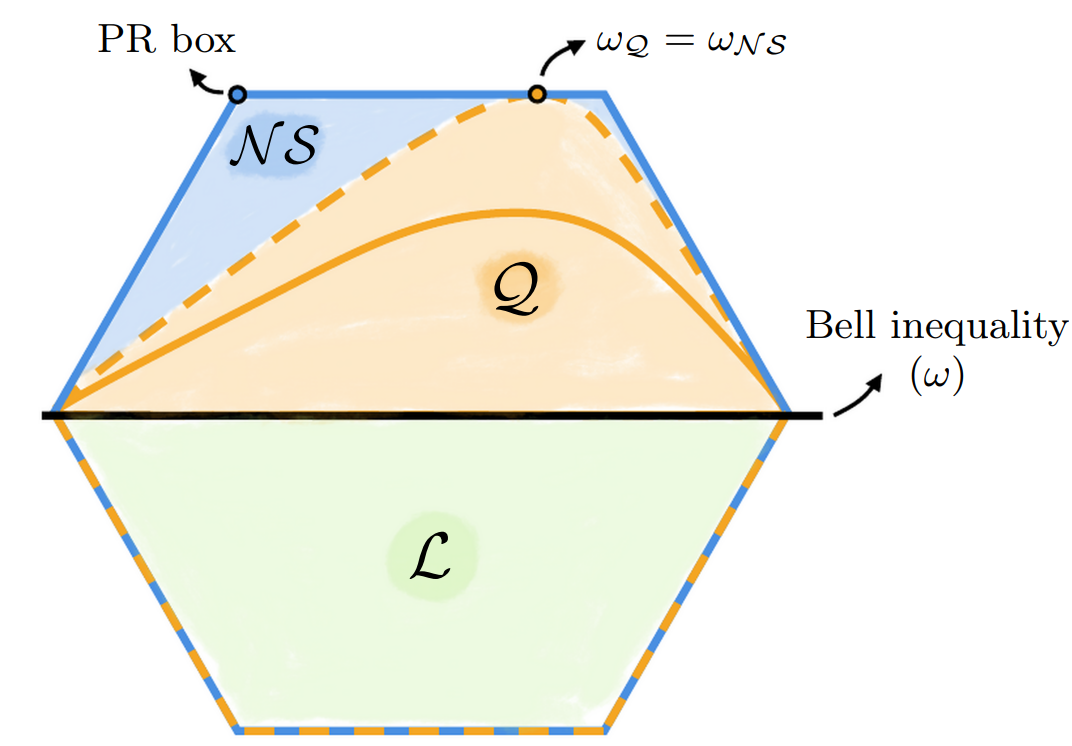
Our work is closely connected to fundamental questions about the nature of quantum theory. Quantum cryptographic tasks provide a particularly useful setting in which abstract quantum phenomena, such as entanglement, steering, Bell nonlocality, can be studied with operational perspective.
We investigate how these fundamental quantum effects constrain the correlations that can be observed in experiments and how they can be turned into useful resources for information processing. In particular, we are interested in understanding the relationship between different forms of quantum correlations, their mathematical structure, and the operational advantages they provide.
We also investigate what are the fundamental limits of quantum cryptography. What assumptions are truly necessary to achieve security? Which assumptions about the quantum state, measurement devices, or sources can be relaxed? And what can still be certified when these components are only partially trusted or completely uncharacterized? By addressing these questions, we explore the boundary between the capabilities of quantum theory and the assumptions required to turn them into secure information-processing tasks.