Numerical methods for cryptography
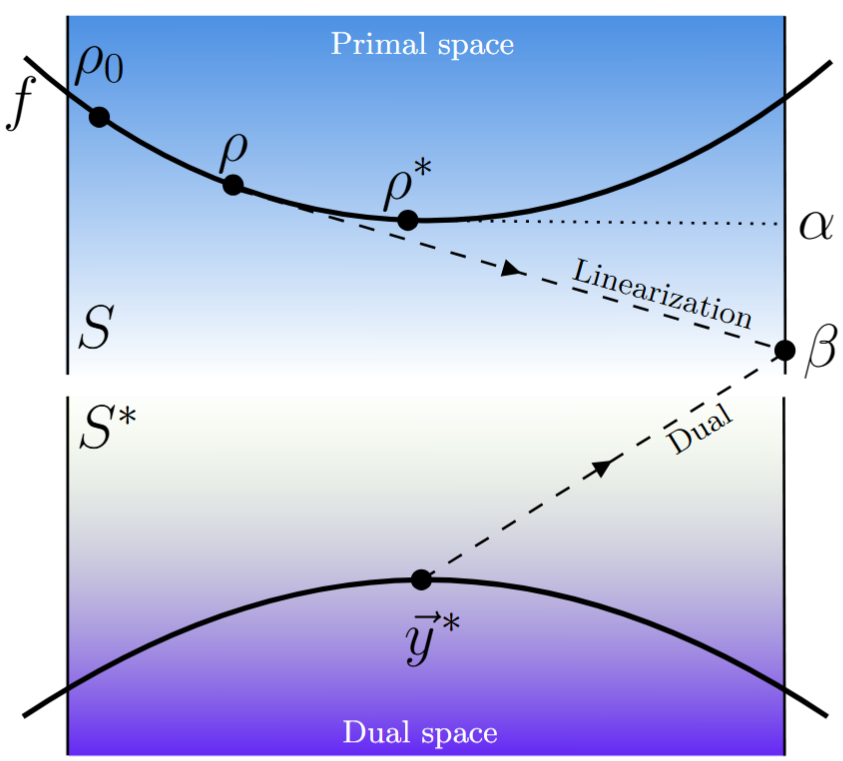
The security of quantum cryptographic protocols is often quantified through quantities such as conditional entropies, which measures how much information an eavesdropper may have about the outcomes of a quantum measurement. These quantities can depend in complicated ways on the observed statistics, the quantum state, measurement settings, and imperfections in a real experiment. As a result, analytical solutions are often possible only for highly symmetric scenarios.
Our research therefore develops and applies numerical methods to study cryptographic protocols in more general and realistic settings. Numerical techniques allow us to investigate the effects of experimental imperfections, noise, losses, and other deviations from ideal assumptions, and to determine how these affect the security and performance of a protocol.
Numerical methods are also particularly powerful in untrusted-device scenarios. Here, the set of quantum correlations compatible with a given experiment is highly constrained but generally difficult to characterize exactly. We use tools such as the Navascués–Pironio–Acín (NPA) hierarchy and related moment-matrix methods to obtain rigorous bounds on the quantum correlations and information available to an adversary. These approaches provide practical numerical tools to certify security based on limited knowledge and experimental data.