Quantum Cryptography without trusted devices
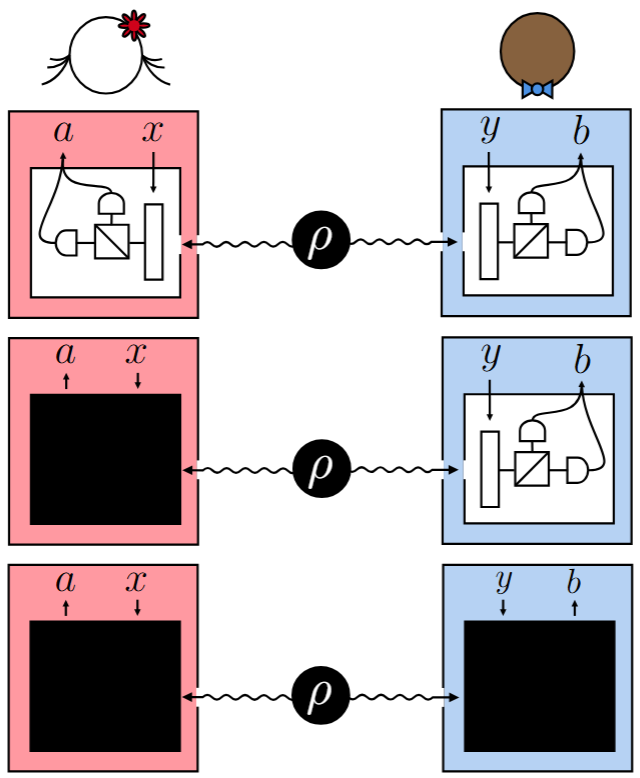
Our theoretical research in quantum cryptography focuses on how different levels of device trust, ranging from fully device-dependent (DD) through one-sided device-independent (1sDI) to fully device-independent (DI), shape the security landscape of quantum cryptography. At the core of our approach is the use of quantum correlations as operational tools: Entanglement is present in most QKD protocols, Einstein-Podolsky-Rosen (EPR) steering is central to 1sDI protocols, where one party's device is untrusted, while Bell nonlocality underpins DI QKD, enabling security even when both devices are treated as black boxes. These correlations allow us to certify randomness and secure key generation under minimal assumptions, going beyond traditional device modeling.
We are especially interested in generalizing these frameworks to multipartite and higher-dimensional systems (qudits), which offer richer structures for nonclassical correlations and open new possibilities for secure communication beyond the standard bipartite qubit setting. These extensions may provide advantages such as greater noise tolerance and improved key rates.