Vienna Mini-Workshop on Thermodynamics, Measurement and Classicality (TMC2026)
9th-10th September | Vienna | AustriaSubmission deadline: 06.07.2026
Registration deadline: 05.08.2026
Registration fee: FREE!
(Posters only, no contributed talks)
Thanks for coming, everyone :)
Key InformationVenue: Atominstitut, TU Wien, Vienna, Austria
Conference Dates: 09.09.2026-10.09.2026
Submission Deadline: 06.07.2026
Registration Deadline: 05.08.2026
Registration Fee: FREE!
Contributions: Talks only from invited speakers, posters only from attendees
AboutThe 2026 Mini-Workshop on Thermodynamics, Measurement and Classicality (TMC2026) is a one-off event to bring together those working on the thermodynamics of quantum measurements and related fields
Join us in Vienna this September for a mini-workshop dedicated to discussions of quantum measurements as dynamical processes, and how this relates to questions around thermodynamics, entropy, information broadcasting, and the emergence of classicality in quantum theory. The intention is for the invited speakers to give long (approx. 120 min) talks providing pedagogical introductions to their approach to these questions, with plenty of time for in-depth discussions with the audience.
Hosting a free workshop such as this means space is limited. We will provide lunch on both days of the conference, but there will be no conference dinner for attendees. Also note that there will be no contributed talks. Applicants may either apply to present a poster, or to simply attend.
We are also hoping to organise tours of the research reactor at the Atominstitut for the attendees. If this event happens, it will be on Friday the 11th of September. Additionally, we hope to organise a visit to one of Vienna's famous "Heuriger" wine taverns on the 11th.
If you wish to attend the workshop but would be unable to arrange travel and accommodation costs, please contact us. It may be possible to assist you financially in extremely limited circumstances.
We hope to see you in Vienna in September!
Confirmed SpeakersLorena Ballesteros Ferraz | CY Cergy Paris Université
Diana Chisholm | University College Dublin
Cyril Elouard | Université de Lorraine
Hamed Mohammady | Institute of Physics, Slovak Academy of Sciences
Mauro Paternostro | Università degli Studi di Palermo
Timetable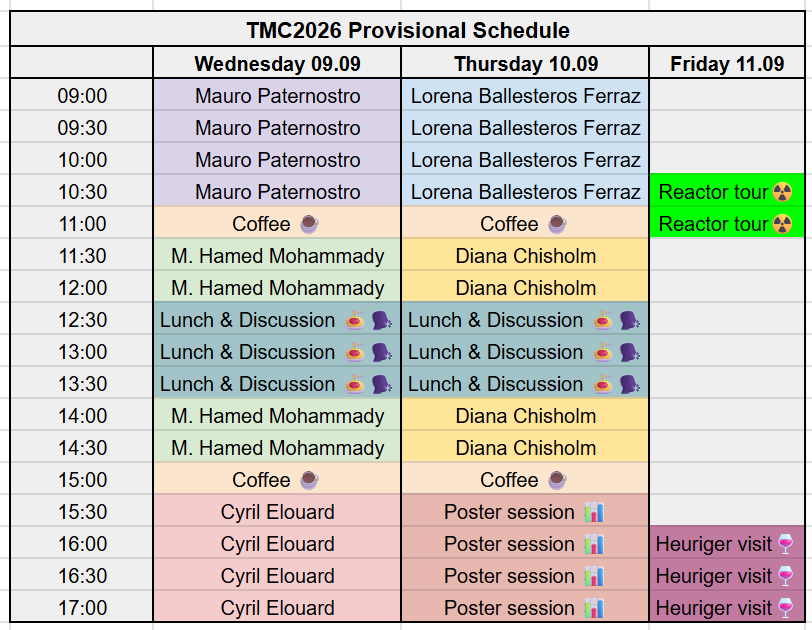
Events scheduled for Friday are not officially part of the conference schedule.
Vienna: useful informationPublic transport
The conference venue is located at the main building of TU Wien’s Atominstitut, located on the Danube canal between Vienna’s 2nd and 3rd districts. It has a direct connection to line U3 (the orange one) of the underground (U-Bahn) train system. The closest station is Schlachthausgasse. Thanks to recent track extension works, the venue can also be reached from Vienna’s main train station (Hauptbahnhof) via tram line 18. (See this link for more information.)
Tickets: several options are available in the Wiener Linien App. The ticket includes unlimited trips anywhere within the city (not including the airport), using any public transport means. Be sure to validate before using it!
Airport: the main airport of Vienna is the Schwechat International Airport (VIE). From there, one can reach the city with the S7 train to Wien Mitte / Landstraße in about 20 minutes. There, U-Bahn connection to the U3 line is possible. The ticket for this journey can be bought in the ÖBB App, and the price is reduced (2,20€) if one also has the weekly ticket (you must select the “Ticket Stadtverkehr Wien (Kernzone) exkl. Jahreskarte” discount type).
An alternative option to reach the city center is the CAT, which has higher prices and is privately operated.
The Atominstitut is reachable within 20 minutes by taxi from the airport.
(There is a chance that the S7 line may not be working all the way during the workshop. If so, the S7 will stop on the outskirts of town and a rail replacement bus service can take you the rest of the way.)
Bratislava airport: there exists the alternative to fly to the Bratislava Airport (BTS), which is relatively close to Vienna and can be sometimes more affordable. To reach Vienna from there, you first need to take the bus 61 to Bratislava hl.st., and then take the REX 8 train to Wien Hbf. You can book your ticket via the ÖBB App.
OrganisersLocal Organising Committee
Iva Březinová (TU Wien)
Marcus Huber (TU Wien)
Maximilian P.E. Lock (TU Wien)
Hanns-Christoph Nägerl (University of Innsbruck)
Tom Rivlin (TU Wien)
Katja Schneeweiss (TU Wien)
Further information following soon!
With funding from